Writer's block can last one session or several years. How long it lasts depends on the type of block and whether the cause gets fixed. Cognitive blocks come from perfectionism and rigid rules. They tend to clear up fast once we spot the pattern. Physiological and motivational blocks can persist until the root cause changes. Below, we break this down by block type with estimates for how long each tends to last and what the evidence suggests.[1]
The Short Answer: It Depends on the Type of Block
Asking "how long does writer's block last" without knowing the type is like asking how long a headache lasts. Is it a tension headache or a migraine? The type shapes both the timeline and the fix.
A recent research review identifies four root causes: physiological, motivational, cognitive, and behavioral.[2] A fifth type, the composition block, is tied to the project rather than the writer. Each type has its own duration, triggers, and recovery path.
The best first step is to find which type of block we have. The type tells us what to do next. The causes are well studied. Knowing our cause points to a clear timeline.[3]
Cognitive Blocks: Hours to Weeks
Cognitive blocks arise from harmful mental patterns during writing. These include perfectionism, premature editing, and rigid rules about the process.[4] A writer who needs a perfect opening sentence before moving forward has a cognitive block. So does one who must polish each paragraph before starting the next.
The pattern here is key. One blocked session may last minutes to hours. That seems mild. But the pattern repeats. Each session triggers the same loop. The block can last weeks or months even though each episode is short. Research on writers with rigid rules found they felt blocked across many sessions. It was not one long freeze but a repeating cycle.[4]
This feels endless because it keeps coming back. But it is a pattern with a clear, fixable cause. Perfectionism and early editing blocks are very common. They are also among the most treatable.
What Makes Cognitive Blocks Resolve Faster
Once we find and challenge the rigid rule, relief can come fast. It may even happen in one session. A writer who stops trying to draft and edit at once often feels a quick shift. Studies show clear gains within weeks for writers who change their drafting process.[5]
Three interventions appear most reliably useful for cognitive blocks:
- Separate drafting from editing: treat them as two tasks done at different times
- Challenge rigid rules: question beliefs like "I must write in order" or "each sentence must be good before I move on"
- Plan on paper first: writing an outline before drafting frees up working memory. We can focus on making text instead of planning and judging at once[6]
The 8-session recovery plan works through this pattern. Most writers see a shift by sessions three and four.
Behavioral Blocks: Weeks to Months
Behavioral blocks are hard to spot. They often do not feel like blocks at all. They look like being too busy or never finding the right time. The key sign is a missing writing habit, not a lack of ability. Behavioral blocks are often missed because they feel like being "just too busy."
Without a crisis to force change, these blocks can last forever. A writer who is "always meaning to get back to it" may go months or years without writing. There is no single dramatic moment of being stuck. Not writing becomes the default.
Research on writers found that short daily sessions beat long rare ones.[5] Those who wrote briefly each day saw real output gains in two to four weeks. The key was not session length. It was writing every day.
The Binge-Writing Trap
Binge writing often keeps these blocks alive. We save writing for rare long stretches when all feels right. But ideal times rarely come. When they do, the pressure to produce creates anxiety. That makes writing harder. Studies show daily writers produce more total work over time. They also feel blocked less often than binge writers.[5]
Recovery takes two to six weeks to build new habits. The block often starts to break in the first week of short daily sessions. But the habit needs four to six weeks to stick.
Motivational Blocks: Weeks to Months (Sometimes Longer)
Motivational blocks come from the emotional side of writing. Fear of criticism, pressure, and avoidance drive them. How long they last varies more than any other type. It depends on whether the fear is tied to a situation or is a lasting trait.
A situational block might come from harsh feedback or a stressful deadline. It tends to fade as the trigger passes. Once the project is done or the rejection fades, the block lifts. These cases may last days to a few weeks.
A trait-based block is different. For some writers, writing fear spreads beyond any single project. It becomes a lasting trait, a deep anxiety about writing itself.[7] These cases can last months or years. The fear-avoidance cycle explains why some blocks get worse over time. Avoidance brings brief relief. But it also stops us from learning that writing is safe. This keeps the fear high.
When Motivational Blocks Become Chronic
The gap between short and long-term blocks matters for recovery. Short-term blocks often respond fast to simple steps. We can lower the stakes, take small actions, or reconnect with why we write. Long-term blocks may need months of steady work. Recovery is rarely a straight line.
Long-term motivational blocks may overlap with clinical anxiety. In that case, the block is a symptom, not a standalone issue. If writing anxiety has become a lasting pattern, broader anxiety treatment tends to work better than writing-only fixes.
Physiological Blocks: Days to Months
Physiological blocks are tied to physical states. Sleep loss, chronic stress, illness, burnout, and depression all play a role. These blocks are unique. They last as long as the physical cause lasts, not based on any mental fix.
Writers most often report physical causes for their blocks.[2] Brain research offers a clear reason. Sleep loss, stress, and depression reduce frontal lobe function. The frontal lobe drives planning and text production. Some blocks may be physical from the start, not mental issues with side effects.[8]
These blocks need a different approach. Our physiological block guide explains why rest is a real fix, not an excuse. Pushing through when the body is drained tends to make the block last longer. Some cases are simple: a bad night of sleep means one bad session. Sleep fixes it. Others, like burnout, have long and uneven timelines.
The Burnout Connection
Burnout deserves a closer look. It often lasts months and goes unseen. Writers may notice their output drops before other burnout signs appear. Writing drains the same resources that burnout depletes. So it serves as an early signal. If the block came before fatigue, detachment, and poor output in other areas, burnout may be the root cause. Recovery needs to account for that.
Composition Blocks: Variable (Project-Specific)
Composition blocks differ from the other types in one important way. They are tied to the project, not the writer. This block appears when a piece has a structural or planning problem that prevents the draft from moving forward. The writer can still produce other work. The issue lives in the project's structure, not in the writer.
Writing has three main steps: planning, drafting, and reviewing.[9] When planning fails, drafting stalls. No amount of effort gets it moving. Composition blocks are project-based. That is good news. The fix is structural, not personal.
The block lasts as long as the structure stays broken. A writer who steps back and reoutlines may fix it in one session. A writer who pushes through a flawed plan may stay stuck for months. The fix is to return to planning, not to push harder at drafting. The sooner we do that, the shorter the block.
Acute vs. Chronic: When Short Blocks Become Long Ones
Any block type can become chronic if the cause is not fixed. There is also a chain reaction worth knowing. It explains why a block that starts as one type can grow into something harder to fix.
Here is a common chain. A cognitive block (perfectionism) leads to bad sessions. The pain leads to avoidance. We start putting off writing to escape the bad feeling. Avoidance is the core of a motivational block. Skipped sessions then break the writing habit. That creates a behavioral block. Then the stress of lost time adds a physiological layer. What started as one block with a fast fix has grown into four. Each one makes recovery longer.
This chain pattern is the top reason blocks last months or years. No single block type is chronic on its own. But unfixed blocks create new problems that become their own barriers.[3]
Three warning signs suggest a short block is becoming a long one:
- Avoidance grows: it spreads from one project to all writing
- Physical signs appear: anxiety, dread, or tension when we think about writing
- Identity shifts: the inner story moves from "I am stuck on this piece" to "I am not a writer"
If this sounds familiar, finding which block types are active now can help untangle the chain. Fixing the first cause may not be enough if new blocks have taken hold.
Evidence-Based Recovery Timelines: A Summary
The table below sums up what research shows about how long each type lasts. These are estimates. Results vary by person. Blocks that involve more than one type will not follow simple timelines.
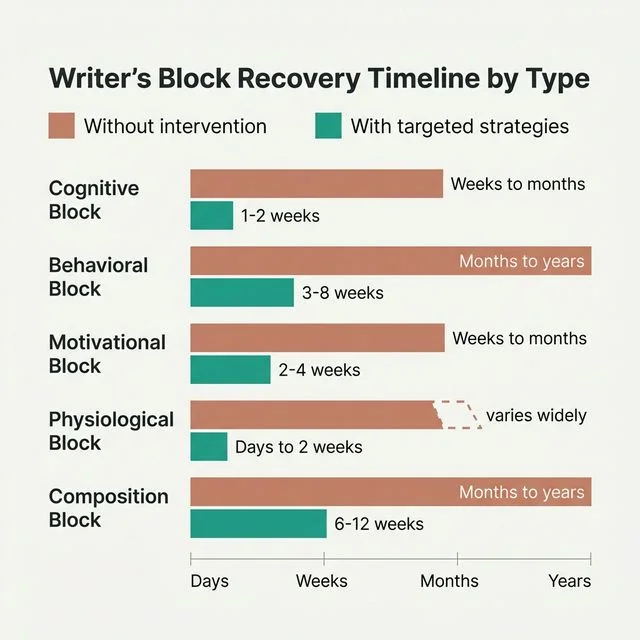
| Block Type | Typical Duration (Untreated) | Recovery With Intervention | Key Intervention |
|---|---|---|---|
| Cognitive | Recurring (session-level) | Days to weeks | Challenge rigid rules; separate drafting from editing |
| Behavioral | Weeks to indefinite | 2–6 weeks | Establish brief daily writing schedule |
| Motivational | Weeks to months (or longer) | Weeks to months | Fix fear source; rebuild writing self-efficacy |
| Physiological | Days to months | Tied to cause resolution | Rest; fix underlying stressor or health condition |
| Composition | Hours to months | Often rapid once found | Return to planning stage; treat as structural, not personal |
For a step-by-step plan, our 8-session plan gives a week-by-week guide with clear steps at each stage.
When to Seek Professional Help
Most writer's block responds to the right fix without outside help. But some blocks have parts that go beyond what writing tips can solve.
Research makes a key distinction between two kinds. Functional writer's block is psychological and responds to behavioral and cognitive interventions. Agraphia is neurological, caused by brain injury or disease, requiring medical evaluation.[8] Functional blocks, no matter how long they last, are generally treatable. But severe and persistent cases may have medical components worth assessing.
Some signs that outside help may be right (these are guides, not diagnostic tests):
- The block has lasted six months or more despite steady efforts to fix it
- Avoidance has spread beyond one project and now affects all writing
- Signs of depression, anxiety, or burnout affect life beyond writing
- Physical signs are present: lasting insomnia, appetite changes, or dread not tied to writing alone
- The block started fast with no clear trigger
Helpful pros include therapists trained in cognitive-behavioral methods and writing coaches. If brain-based concerns are present, a doctor may help. Seeking help shows clear thinking. Some blocks are signs of something bigger. Fixing the root issue is often the fastest path back to writing.
What We Can Do Right Now
The core finding is this: how long a block lasts depends on its type. Finding the type is the most useful thing we can do. A block that feels endless may be cognitive. It can clear up in days once we stop editing while drafting. A block that feels like laziness may be behavioral. Two weeks of short daily sessions can fix it. A block that feels personal may be a composition issue. The project plan is broken, not us.
Three concrete next steps, in order:
- Find the block type. The quiz helps us spot which pattern is active or which mix is at work.
- Match the fix to the type. Cognitive blocks need draft-edit splits. Behavioral blocks need a set routine. Motivational blocks need fear-facing steps. Physiological blocks need rest. Composition blocks need a return to planning. The wrong fix for the right block rarely helps.
- Give the fix enough time. Cognitive blocks may shift in days. Behavioral blocks need weeks. Motivational blocks, when chronic, need months. Hoping for a fast fix often deepens the block. Knowing the real timeline is part of the cure.
Research shows that writer's block is a family of distinct types. Each has its own arc and evidence for what works. This can be reassuring. What feels like an endless, shapeless block is almost always a clear, treatable pattern. The path out starts with naming it.
References
- Duration estimates throughout this article are synthesis estimates derived from intervention and treatment studies rather than from longitudinal duration data. This remains a gap in the writer's block research literature. See notes 2–9 for specific sources. ↑
- Ahmed, S. J., & Güss, C. D. (2022). An analysis of writer's block: Causes and solutions. Creativity Research Journal, 34(3), 339–354. https://doi.org/10.1080/10400419.2022.2031436 ↑
- The longitudinal trajectory of writer's block (how blocks evolve, compound, and interact over time) remains understudied. Most published research is cross-sectional, capturing writers at a single point. This represents a meaningful gap in the literature for practitioners working with chronic cases. ↑
- Rose, M. (1984). Writer's Block: The Cognitive Dimension. Southern Illinois University Press. (ERIC ED248527) ↑
- Boice, R. (1985). Cognitive components of blocking. Written Communication, 2(1), 91–104. https://doi.org/10.1177/0741088385002001006. See also Boice, R. (1990). Professors as Writers: A Self-Help Guide to Productive Writing. New Forums Press. ↑
- Kellogg, R. T. (1996). A model of working memory in writing. In C. M. Levy & S. Ransdell (Eds.), The Science of Writing: Theories, Methods, Individual Differences, and Applications (pp. 57–71). Lawrence Erlbaum Associates. ↑
- Daly, J. A., & Miller, M. D. (1975). The empirical development of an instrument to measure writing apprehension. Research in the Teaching of English, 9(3), 242–249. ↑
- Flaherty, A. W. (2004). The Midnight Disease: The Drive to Write, Writer's Block, and the Creative Brain. Houghton Mifflin. ↑
- Hayes, J. R., & Flower, L. S. (1980). Identifying the organization of writing processes. In L. W. Gregg & E. R. Steinberg (Eds.), Cognitive Processes in Writing (pp. 3–30). Lawrence Erlbaum Associates. ↑