What the Research Says
Study of over 1 million persuasive texts
Layered arguments beat simple ones. Clear logic between points won out over flat messages.
A review of 64 studies found that stories boost persuasion by lowering our guard against new ideas. This goes against the old common advice of keeping it short and simple.
What Makes Op-Eds Work
A study of 3,500+ people tested real op-eds:
- Shift: Views moved ~0.5 points on a 7-point scale
- Lasting: Effects held for at least one month
- Broad reach: Both parties and swing voters moved
- Cheap: "$0.50 to $3.00 per mind changed"
Why Layers Beat Simplicity
Common advice says to keep it simple with one idea per block. But research shows the most persuasive texts have layered, nested points.
This does not mean tangled prose. It means building a clear chain of logic with real depth at each step.
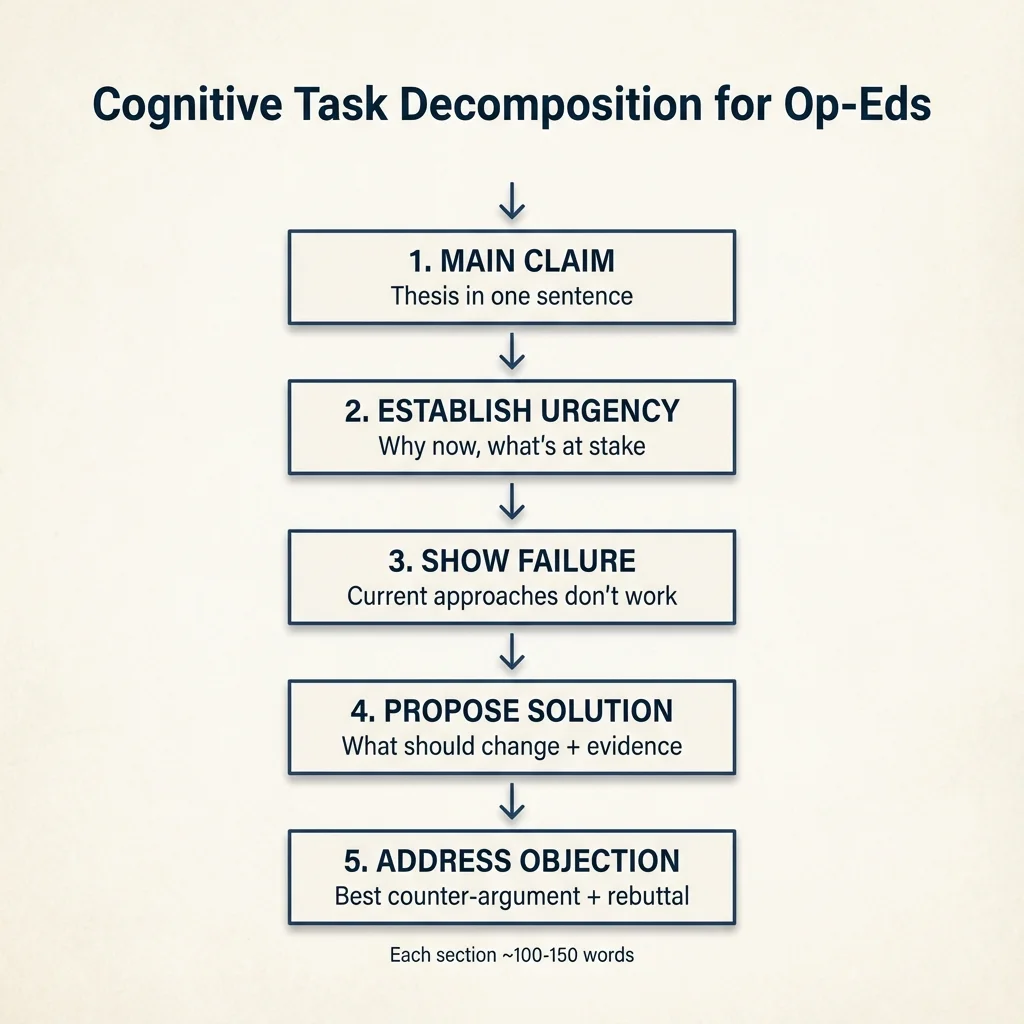
- Main Claim: Thesis in one line
- Task 1: Show urgency (why now, what is at stake)
- Task 2: Show what has failed (what was tried, proof it failed)
- Task 3: Name a fix (what should change, proof it works)
- Task 4: Handle the best pushback (top objection, why we still hold)
How to Use Proof Well
Use Numbers, Not Vague Words
Vague phrases like "some proof shows" cut sharing by about 50%. But putting numbers on our claims boosts trust instead. Five experiments with 5,780 people found "73% likely" seemed MORE credible than bold absolute claims.
Skip "Studies show pre-K helps kids." Write: "A review of 22 trials (15,000 kids) found pre-K raised reading scores by 0.35 SD (95% CI: 0.28-0.42)."
How Many Sources?
Use 2-4 strong sources per 750 words. Put the best proof early, in blocks 2-4. That is where readers pay the most heed.
Why Stories Lower Our Guard
Review of 64 studies (138 effect sizes)
Stories boost engagement and understanding. When readers get pulled into a narrative, their resistance drops because stories activate different cognitive paths than pure argument.
What makes a story pull readers in:
- Named people (not vague groups)
- Real scenes (not abstract ideas)
- Events in order (a clear timeline)
- Stakes that matter
Blend Story and Proof
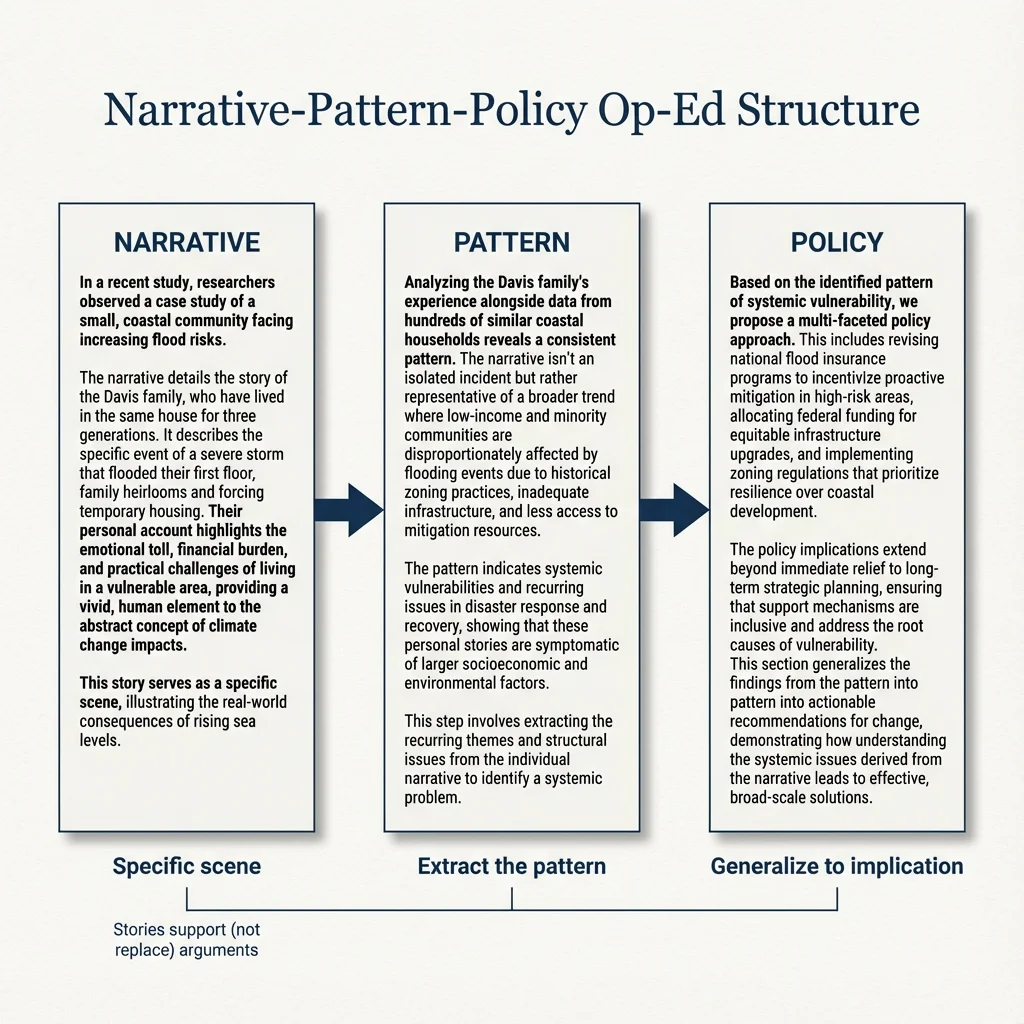
Use this flow: Story, then Pattern, then Policy.
- Block 1: A specific scene (100 words)
- Block 2: Pull out the pattern (100 words)
- Block 3: Apply it to policy (100 words)
The Clarity Trap
Clear writing matters, but making things too simple backfires. At first, simple text seems more credible. In the end though, readers trust genuine depth more than easy answers.
- Mix line lengths: Short for punch. Medium for detail. Cap at 40 words.
- Define hard terms: Use them, but explain: "epistemic doubt (what we don't know)"
- Aim for FK Grade 8-10 and Reading Ease 60-70
The Op-Ed Process
- Step 1 (30 min): Plan first. Break it into the 4 tasks above.
- Step 2 (90 min): Write the body first. Skip the intro. Draft blocks 2-6.
- Step 3 (20 min): Write the intro last. Hook, bridge, thesis.
- Step 4 (15 min): Check clarity. Run an FK test. Split long lines.
- Step 5 (15 min): Add real numbers. Swap vague claims for data.
- Step 6 (10 min): Check depth. Each block needs a claim, proof, and point.