Writing advice loves extremes. "Be concise." "Add more detail." "Cut the fluff." "Develop the idea." Rarely does anyone tell us how to know whether our prose is too packed or too sparse. We get the prescription without the measurement.
Lexical density gives us that measurement. It is the ratio of content words (nouns, verbs, adjectives, adverbs) to total words in a passage. Content words carry meaning; function words ("the," "is," "of," "and") provide the grammatical scaffolding that holds meaning together. The ratio between them tells us something concrete about how much information each sentence asks a reader to absorb.
A passage where 75% of the words carry independent meaning is dense in a literal, measurable sense. One where 40% carry meaning feels lighter, more conversational. Neither is inherently better. But knowing which register we are operating in, and whether it matches our audience, turns out to be more useful than most general writing advice.
What Lexical Density Actually Measures
Every sentence contains two kinds of words. Content words do the heavy lifting: decision, shape, environmental, rapidly. Function words do the connecting: the, it, is, that, of, are, there. Lexical density is simply the proportion of content words in a passage.
We rarely calibrate information load well by instinct. We tend to write at whatever density feels natural, which often means we write for ourselves rather than for our readers. Measuring the ratio makes the invisible visible.
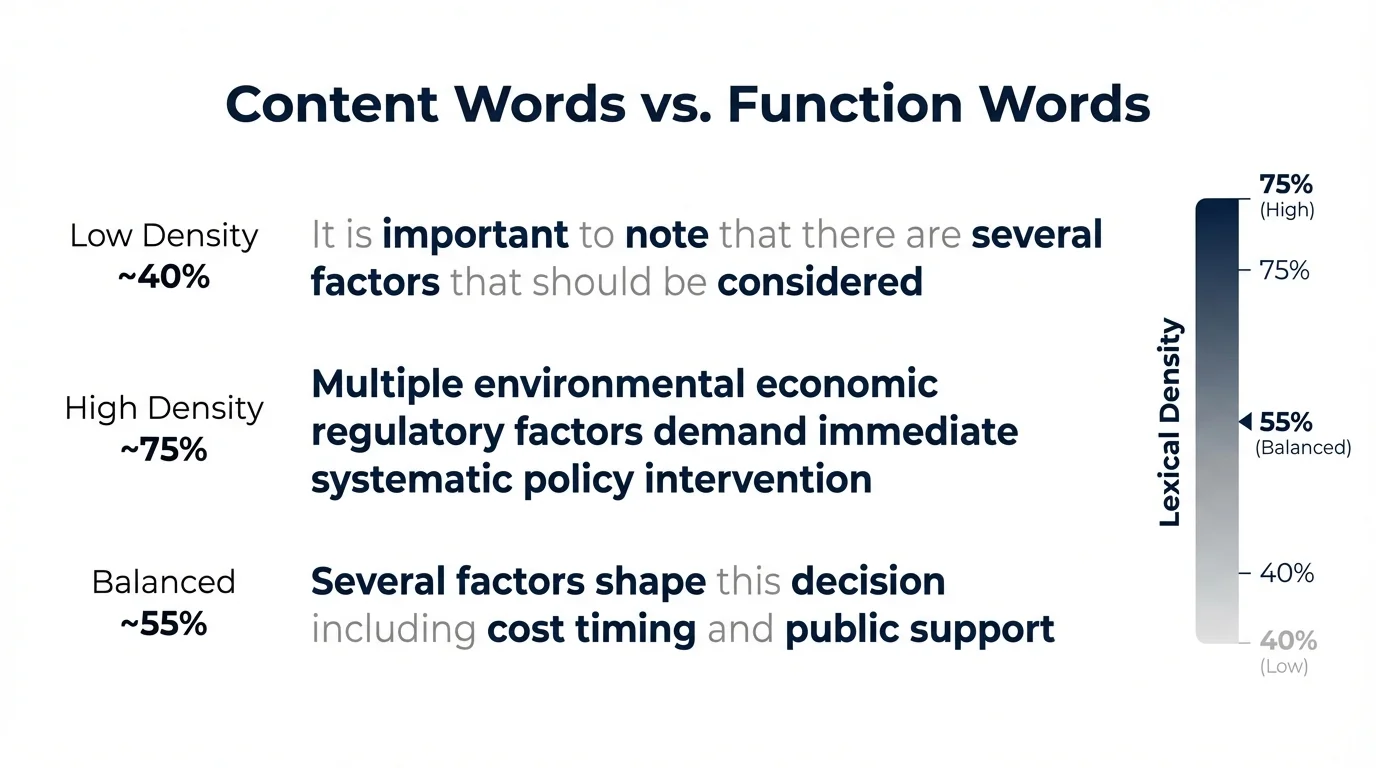
Consider three versions of roughly the same idea:
Low density (~40%): "It is important to note that there are several factors that should be considered when we are making this kind of decision."
That sentence has 21 words, but only about 8 carry meaning. The rest ("it is," "that there are," "that should be") are structural padding. The information-to-word ratio is low. This is what first drafts often look like: the ideas are present, but they are wrapped in extra scaffolding.
High density (~75%): "Multiple environmental, economic, regulatory factors demand immediate systematic policy intervention."
Nine words, nearly all content-bearing. The sentence strips away grammatical connective tissue entirely. Each word carries weight, which means the reader processes meaning at every step with no breathing room. Academic writing and technical reports often land here.
Balanced density (~55%): "Several factors shape this decision, including cost, timing, and public support."
Eleven words with a comfortable mix of content and function words. The function words ("this," "and") give the reader micro-pauses between chunks of meaning. The sentence moves efficiently without becoming a wall of terminology.
The difference between these versions comes down to cognitive load. Each communicates the same core idea, but the reading experience varies from effortful to breezy to balanced.
Ranges and What They Mean
Lexical density is not a single target to hit. Different kinds of writing naturally fall into different ranges, and the goal is to match our density to our purpose and audience.
Under 40%: Probably wordy. Prose in this range tends to be padded with filler constructions: "it is the case that," "there are many ways in which," "the fact that." This is common in first drafts and in writing that is trying to sound formal without having much to say. If we land here, there are usually easy cuts available.
40 to 55%: Conversational and accessible. Blog posts, journalism, newsletters, and most general-audience writing falls in this band. The balance of content and function words creates a reading rhythm that feels natural. Readers can move quickly without losing the thread.
55 to 65%: Information-rich. Technical communication, policy reports, and detailed how-to guides often sit here. The prose is efficient, carrying more meaning per sentence. Readers can handle this density when they are motivated and the subject demands it, but it requires more attention.
65 to 75%: Academic register. Peer-reviewed journal articles, legal briefs, and specialized technical writing frequently operate in this range. The density is appropriate for expert readers who share the writer's vocabulary, but general audiences will find it difficult to parse.
Above 75%: Approaching unreadable. Even expert readers struggle with prose this dense. When nearly every word carries independent meaning, the reader has no resting points. If we find ourselves here, breaking sentences apart and adding a few connective phrases will help without diluting the content.
The more useful question: does our density match the audience we are writing for? A blog post at 70% is probably too dense. A technical specification at 40% might be too thin.
Vocabulary Sophistication: The Other Half of Complexity
Lexical density tells us about information load, but vocabulary sophistication tells us about accessibility. These are related but distinct. A passage can be high-density with simple words, or low-density with complex ones.
Vocabulary sophistication measures how much of our word choice draws from common, everyday language (roughly the top 500 to 1,000 most frequently used words) versus less common, specialized terms. A passage where 10% of the words fall outside common usage reads as accessible and plain. One where 45% are uncommon reads as specialized or technical.
The mismatch problem is where this gets interesting. Using specialist vocabulary for a general audience creates unnecessary barriers, even if the sentence structure is simple. Conversely, avoiding precise technical terms when writing for experts can feel patronizing or imprecise. The goal is calibration, not minimization.
A related metric, the type-token ratio, measures vocabulary range. It compares the number of unique words to total words. A high type-token ratio means we are using many different words (varied vocabulary); a low one means we are repeating the same words frequently. Neither extreme is ideal. Repeating key terms can aid clarity in technical writing, while varied word choice keeps narrative prose from feeling monotonous.
Together, these three measures (lexical density, vocabulary sophistication, and type-token ratio) give us a more complete picture of how our prose behaves than any single readability score. They help us see why a piece reads the way it does, beyond a simple "hard" or "easy" label.
Contractions as a Formality Dial
Contraction frequency might be the simplest and most actionable feature of prose style. The presence or absence of contractions is one of the clearest signals of register.
"We cannot ignore these findings" reads differently from "We can't ignore these findings." The information is identical. The density is identical. But the formality shifts perceptibly. Academic papers, legal documents, and formal reports typically avoid contractions. Blog posts, newsletters, and conversational guides use them freely.
This makes contraction frequency a useful dial to turn when we want to adjust the feel of a piece without changing its content or structure. If a blog post reads as stiff, increasing contractions is often the fastest fix. If an analysis memo feels too casual, removing them tightens the register. It is a small change with an outsized effect on tone.
Checking and Adjusting Our Density
The Writing Style Analyzer on this site measures all of these: lexical density, vocabulary sophistication, type-token ratio, and contraction frequency. Pasting in a draft and seeing the numbers can be genuinely clarifying, especially when a piece feels "off" but we cannot pinpoint why.
If the density is too high, a few strategies tend to help. Adding transitional phrases ("as a result," "in other words") introduces function words that give readers breathing room. Using pronouns to reference previously stated ideas avoids restating dense noun phrases. Breaking a single information-packed sentence into two shorter ones spreads the cognitive load across more reading time.
If the density is too low, the approach is different. Cutting filler phrases ("it is important to note that," "there are several ways in which") removes function words without losing meaning. Replacing weak verb constructions ("is able to," "has the ability to") with specific verbs ("can," "enables") compresses the scaffolding. Looking for sentences that say very little in many words, and asking what they actually contribute, tends to reveal the places where prose can be tightened.
The point of measuring is to make our intuitions about readability concrete, so we can adjust deliberately rather than guessing.