Differential Diagnosis
Four questions help spot motivational blocks:
- Do we have energy for other hard tasks?
- Could we write if a big deadline hit?
- Do we avoid writing but not other things?
- Do we know we're ducking writing?
Signs of motivational block: normal energy, able to write if forced, feeling "I don't want to" (not "I can't"), and habits of putting it off.
Key sign: We know we're avoiding it. We don't feel unable.
Implementation Intentions
Gollwitzer, P. M. (1999). Implementation Intentions
If-then plans raise task done rates from 32% to 71%. They create auto-pilot responses. Effect size d = 0.65 across 94 studies.
- 1. Pick a Writing Cue (daily, needs no drive): "When my 12pm alarm goes off.."
- 2. Set a Clear Action: "..then I close email and open draft.docx for 15 minutes"
- 3. Write the Plan: Format: "If [CUE], then I will [ACTION]."
- 4. Test It: Does the cue happen on its own? Can we do it with no drive?
![Formula diagram showing IF [specific cue] THEN [specific action] with example: IF 12pm calendar reminder THEN close email, open draft.docx for 15 minutes. Shows 32% to 71% completion rate improvement](/images/figures/motivational-implementation-intention.webp)
Common Pitfalls
- "If I have free time.." → Use real time markers
- "Then I will write my novel.." → Name the file, time, and word goal
- "If I feel like it.." → The cue must not need drive
External Accountability
Outside deadlines bring 2.2-5.2x better results. They create social stakes that trump mood swings.
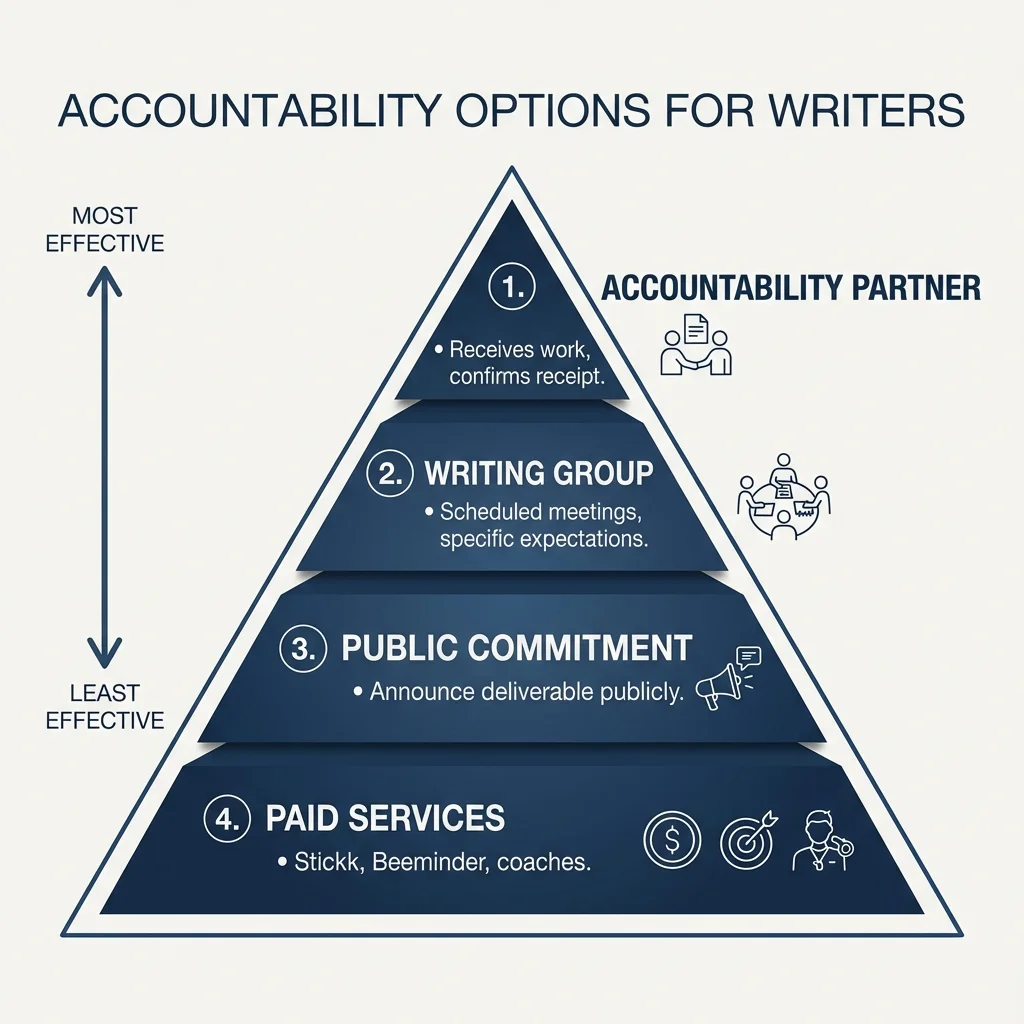
4 Accountability Options
- Partner (Best): Someone who gets our work by a due date and says "got it"
- Writing Group: Set meetings, clear goals, mild stakes
- Public Pledge: Tell people what we'll finish and when
- Paid Tools: Stickk.com, Beeminder.com, or writing coaches
Environmental Design
Make writing the easy choice. Make avoiding it harder. Studies show 30-60% gains when we tune the friction.
- Set up a user account with no email or social media
- Open the draft file in advance; leave the cursor at the next line
- Add a one-click shortcut to the draft on the desktop
- Turn phone screen-down or put in different room
- Use website blockers (Freedom, Cold Turkey, StayFocusd)
- Log out of social media after each use
Autonomy Restoration
When drive fails, a core need may be blocked. Often, the root is lost sense of choice.
"Could" → "Choose to" Reframe
- "I have to finish this chapter" → "I'm choosing to work on this chapter today"
- "I should be writing" → "I could write right now if I want to"
"Have to" fires up resistance. "Choose to" fires up drive.
Permission to Quit
Write: "I could stop [project] right now. What would happen?" If real value shows up, we feel in charge again. When quitting feels off the table, going on feels forced.