When Traditional SMART Goals Work Against Writers
The Outcome Trap
Goals based on results help with simple tasks. But they hurt complex tasks that need learning or creative thought. Writing is both complex and learning-heavy.
The Word Count Trap
Word counts rule writing goals because they are easy to track. But this leads us astray. A NaNoWriMo study found daily word count goals made 67% of writers skip planning, cut revision, and chase speed over quality.
The Pass/Fail Trap
SMART goals are binary: we hit the mark or we fail. But writing rarely moves in a straight line. A 38,000-word draft with strong parts is not a failure. It is progress. Yet binary goals code it as failure. This starts a cycle: fall behind, feel like a failure, then stop. This cycle mirrors how writing anxiety takes hold.
What Makes Writing Goals Different
Writing is not linear. We jump between planning, drafting, and revising. A session with zero new words but a solved concept can spark a 5,000-word burst the next day.
- Quality is fuzzy: Our skill at judging our own work grows slow and varies by level
- Safety matters: We need room to try bad ideas. Outcome goals cut that safe space.
The Research-Based Alternative: Process-Focused Goals
Implementation Intentions
Research shows if-then plans beat outcome goals for reaching targets.[1]
- Outcome goal: "Write 50,000 words this month."
- If-then plan: "If it's 7:00 AM on a weekday, then I write for 25 minutes before email."
Mastery Goals vs. Performance Goals
Growth goals (building skill) predict:
- More grit through hard spots
- Stronger inner drive
- Better results on hard tasks
- Less worry and perfectionism
Output goal: "Publish three articles this year."
Growth goal: "Get better at making clear points."
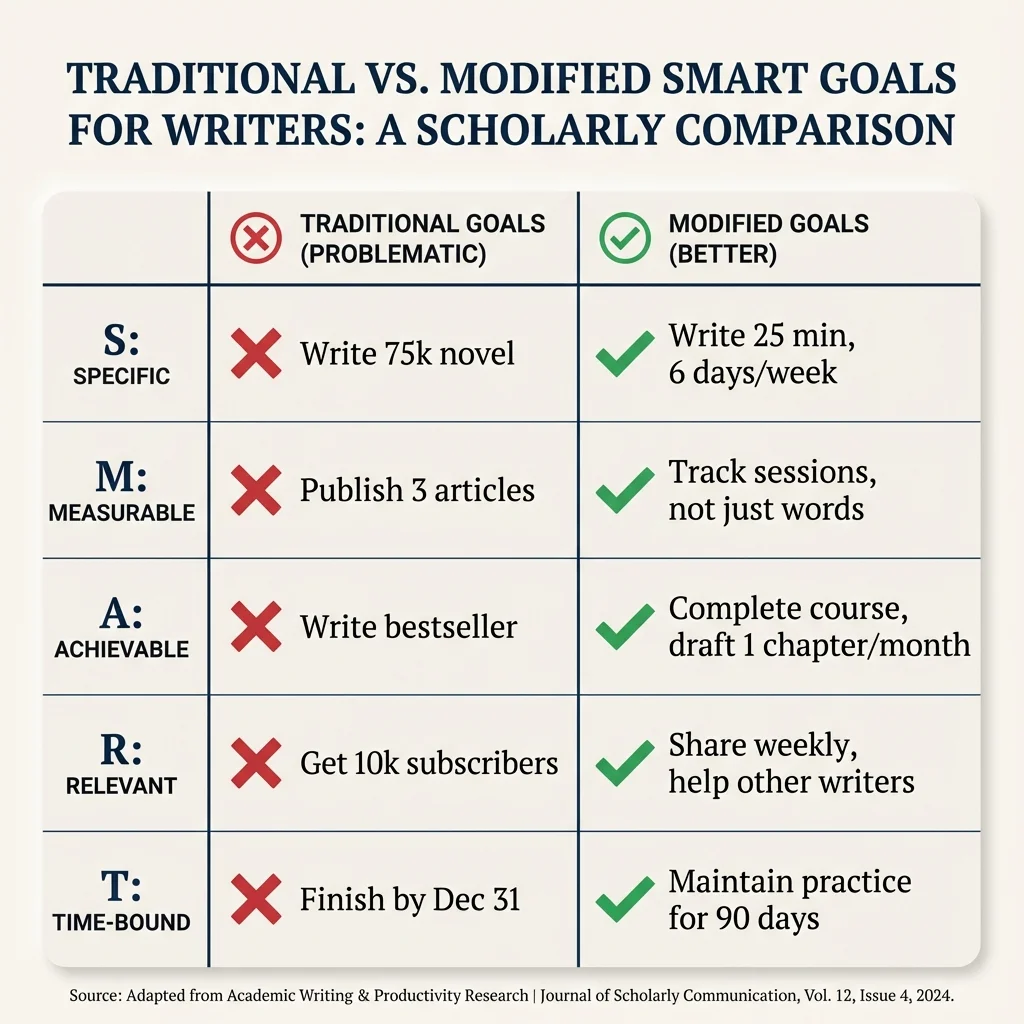
The Modified SMART Framework for Writers
- S - Specific Process: "Write for 25 minutes, six days a week" (not "Write a 75,000-word novel")
- M - Track Actions: Count sessions and time, not just words
- A - Build Skills: "Finish a course, draft one chapter per month"
- R - Tied to Values: Link to inner goals (growth, giving) not outer ones (fame, money)
- T - Steady Rhythm: "Write daily for 90 days" (not hard deadlines)
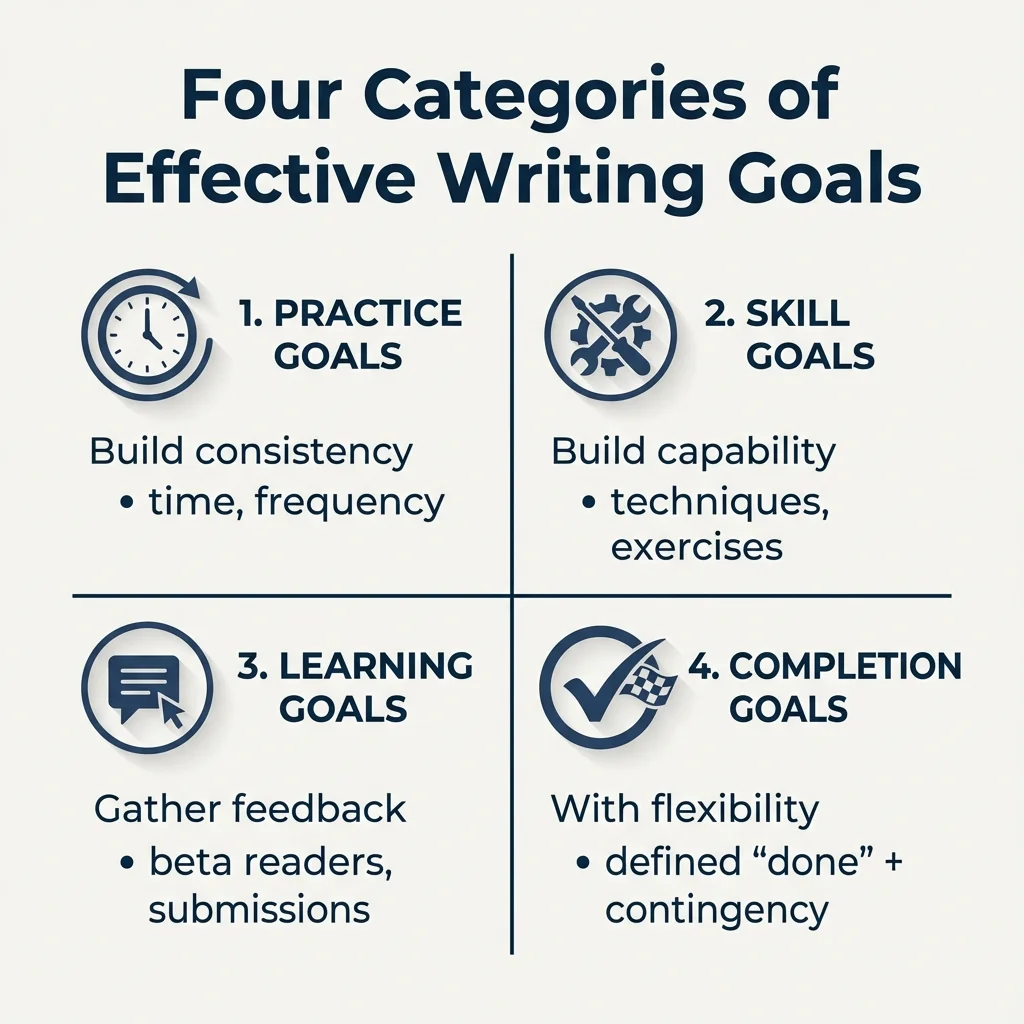
Four Categories of Effective Writing Goals
1. Practice Goals (Building Consistency)
- "Write for 20 minutes before breakfast, Monday through Friday"
- "Complete three writing sessions per week, minimum 15 minutes each"
2. Skill Goals (Building Ability)
- "Try three line-edit methods this month"
- "Do one dialogue drill each week"
3. Learning Goals (Getting Feedback)
- "Share drafts with two beta readers and get their notes"
- "Send five stories out and track what comes back"
4. Finish Goals (With Flex Built In)
- "Finish a first draft by month's end. 'Finish' means a rough draft that covers all parts, not polished prose."
- Have a backup plan: "If the ending is not solved by week five, share with our critique group."
How to Track Goals Without Triggering Perfectionism
Use Threshold-Based Tracking
- Linear target: "Write 500 words/day. Today: 342. Behind by 158." (Feels like failing all the time)
- Threshold: "Write at least 15 min/day. Today: 23 min. Done." (Clear win)
Track Streaks, Not Totals
Totals keep the gap in our face. Streaks highlight drive. Studies show streak tracking beats total tracking for staying on course.
Separate Process Metrics from Outcome Metrics
- Process numbers (in our control): Sessions done, days of practice, notes asked for
- Outcome numbers (less control): Words written, projects done, pieces accepted
Check process numbers each week. Check outcome numbers each month or quarter.
Good writing goals put process over outcome, steady work over bursts, skill growth over piling up words, and flex over rigid rules.
References
- ^ Gollwitzer, P. M., & Sheeran, P. (2006). Implementation Intentions and Goal Achievement: A Meta-Analysis of Effects and Processes. Advances in Experimental Social Psychology, 38, 69-119.