The Monotony Problem
Something most of us never notice in our own writing: every sentence comes out roughly the same length. We draft a paragraph, and each line lands somewhere around 16 words. Then the next paragraph does the same thing. And the next.
The result feels flat. Forgettable.
Research on writing quality consistently finds that sentence length variation correlates with how engaging readers find a piece of text. When the rhythm stays constant, readers start skimming. Their attention drifts. The prose blurs into a wall of sameness, regardless of how strong the ideas are.
Most of us have no idea what our sentence length distribution actually looks like. We sense when something feels choppy or when a paragraph drags, but we rarely connect that feeling to a measurable pattern. Once we start looking at the numbers, though, the relationship between rhythm and reader engagement becomes hard to ignore.
What the Research Says
Cognitive research on writing and reading offers some anchors.
Ronald Kellogg's work on writing cognition suggests that sentence processing draws on working memory in predictable ways. When sentences follow a repetitive pattern, readers can start to "autopilot," reducing the depth of engagement with each successive line. Variety in sentence structure seems to keep working memory active, which in turn supports comprehension and retention.
Readability research complicates the old idea that shorter is always better. The optimal sentence length depends on genre and audience. Technical instructions benefit from brevity. Narrative nonfiction benefits from longer, more layered constructions that carry the reader through a sequence of ideas. There is no single ideal number.
Cognitive load theory gives us a useful heuristic: when the idea itself is complex, shorter sentences help by reducing the processing burden per unit. When the content is straightforward or the writer is building narrative momentum, longer sentences can carry more context without overwhelming the reader.
Then there is the "one idea per sentence" rule, which shows up in nearly every writing guide. In practice, skilled writers break this rule constantly. A well-constructed compound sentence can hold two related ideas in tension, letting the reader see a connection that two separate sentences would obscure. The guideline is a reasonable starting point for clarity, but treating it as a hard rule tends to produce prose that feels mechanical.
The Numbers in Context
Once we start measuring, it helps to know what different averages actually feel like on the page.
Under 12 words per sentence. This range reads as telegraphic, urgent, almost clipped. It works well for action sequences, step-by-step instructions, and short-form persuasion. Hemingway's fiction often lands here. Seth Godin's blog posts do too. Over a long piece, though, this pace becomes exhausting. There is nowhere for the reader to rest, and the relentless brevity starts to feel like being poked.
12 to 18 words. Punchy and direct. This is the range most journalism occupies, along with most successful blog writing. It is broadly accessible. Sentences at this length can carry a complete thought without asking the reader to hold too much in working memory at once.
18 to 25 words. Balanced, with room to breathe. Essays, longform features, and narrative nonfiction tend to land here. At this length, we can introduce subordinate clauses, build qualifications, and layer ideas without losing the reader. This range works well for explaining nuanced topics where oversimplification would be a disservice.
25 to 35 words. Expansive and layered. Academic writing, literary nonfiction, and some opinion journalism operate in this territory. Pulling it off requires skill. Every extra clause needs to earn its place, because the reader's working memory is under real strain at this length.
Over 35 words. Dense and demanding. Legal writing, philosophical argument, and certain literary styles push into this range. Most general audiences will struggle here. The ideas may be accessible, but the sentence structure itself becomes a puzzle to parse.
Standard Deviation Matters as Much as the Average
Most writing guides skip this entirely. A piece with an average sentence length of 17 words sounds perfectly reasonable. But if every sentence is between 15 and 19 words, the prose will still feel monotonous.
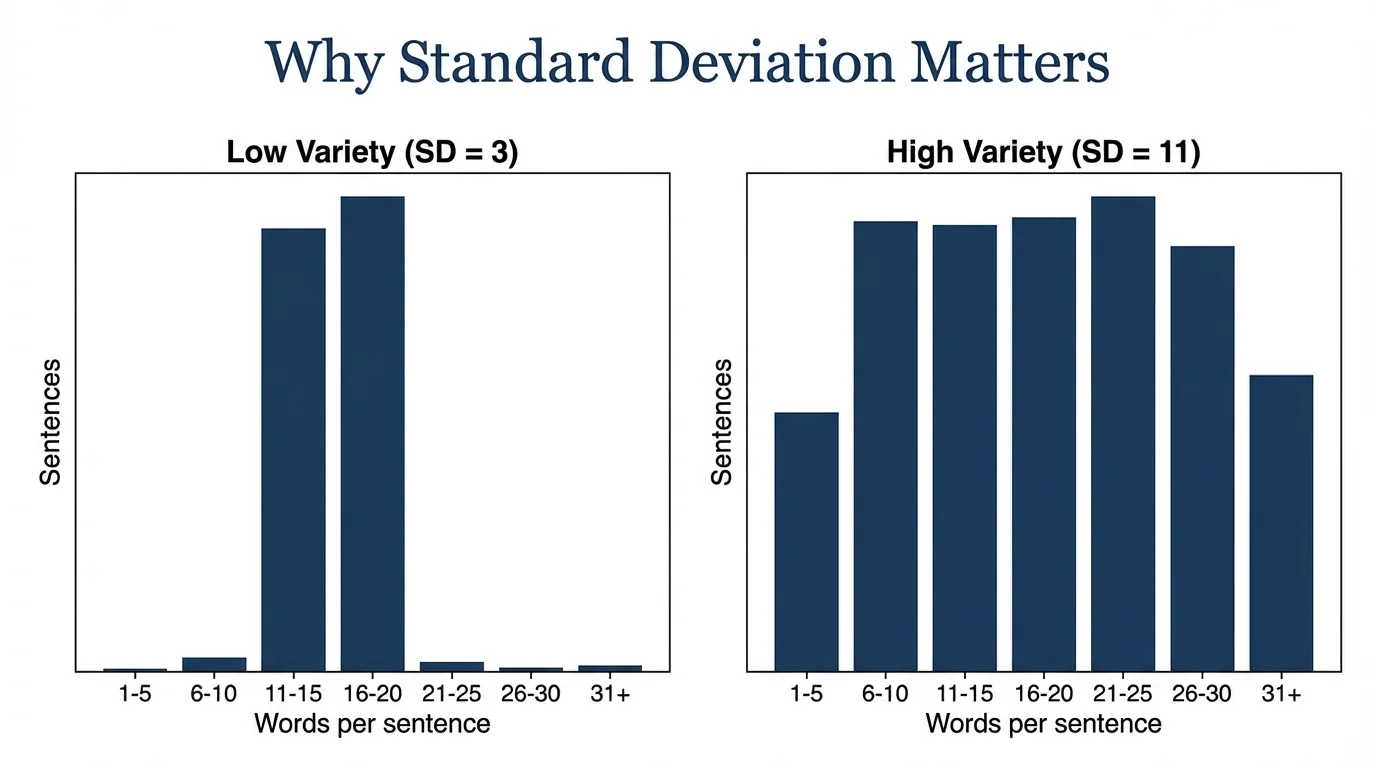
Standard deviation tells us how much variety exists around that average. A low SD (under 5) means nearly every sentence is close to the same length. Even at a good average, this produces a metronomic quality that readers register as dull. A high SD (over 10) means the writer is deploying dramatic contrasts: short punches followed by longer, more elaborate constructions. This kind of deliberate range is what gives prose its rhythm.
The sweet spot for most writing seems to fall between 6 and 10. Enough variety to keep the reading experience dynamic, without so much inconsistency that the reader feels jerked around.
The Complexity Mix
Sentence length and sentence structure are related but not identical. Two 20-word sentences can feel completely different if one is simple (subject-verb-object with modifiers) and the other is compound-complex (two independent clauses linked by a conjunction, with a dependent clause tucked in).
A healthy mix for narrative prose looks something like this:
- Simple sentences (roughly 40%): These carry the main assertions. They ground the reader.
- Compound sentences (roughly 30%): Two related ideas joined by a conjunction or semicolon. These create connections and show relationships.
- Complex sentences (roughly 20%): One independent clause with a dependent clause. These introduce conditions, causes, and qualifications.
- Compound-complex sentences (roughly 10%): The most layered structure. These work best sparingly, when an idea genuinely requires multiple moving parts.
These proportions work as a rough guideline, not a prescription. What feels natural shifts with genre. Academic prose might push the complex and compound-complex percentages higher. Flash fiction might lean harder on simple sentences.
When every sentence uses the same structure, readers notice the repetition even if they cannot name it. All-simple prose sounds choppy, like a children's book. All-complex prose sounds academic, like a dissertation. The mix is what creates the impression of a human voice.
How to Check and Adjust
The Writing Style Analyzer on this site measures all of this: average sentence length, standard deviation, min and max lengths, and the complexity mix across a given text sample.
If the standard deviation comes back under 5, that is a signal to look for places where we can either break a long sentence into two shorter ones or combine a pair of short sentences into a single, more flowing construction. The goal is to introduce enough variation that the rhythm stops being predictable, not to revise every sentence.
If the average is above 25 for a general audience piece, the compound-complex sentences are the first place to look. Often these can be split without losing meaning. Sometimes a semicolon does the work of a subordinate clause with less cognitive overhead.
Reading aloud remains the most reliable test. Our ears catch monotony faster than our eyes do. If a paragraph sounds like a metronome when we read it out loud, the sentence lengths are probably too uniform, regardless of what the numbers say.
For more on resisting the urge to fix these things mid-draft, see Stop Editing While Writing. And for applying these ideas specifically to research writing, The Science of Clear Academic Prose goes deeper into how sentence architecture interacts with argument structure.
Sentence Length Is a Tool, Not a Rule
None of this is about hitting a target number. A piece with an average of 22 words is not inherently better than one averaging 14. The question is whether the length and variety serve the content and the audience.
What matters is intentionality. When we understand what our sentence length distribution looks like, we can make deliberate choices about rhythm instead of leaving it to habit. Short sentences can punch. Long sentences can carry the reader through a complex thought. The contrast between the two is what creates momentum.
The numbers are just a mirror. They show us what we are already doing, so we can decide whether that is what we actually want.