Why Routines Fail Early
Three patterns cause failure:
- Goals too big: Aiming for 1,000+ words daily breeds stalling. It can turn into a full motivational block.
- No triggers: Without set cues, we rely on willpower. That fades through the day.
- No quick reward: Writing has slow payoffs. Distant rewards don't build habits well.
2021 study of 1,200 writers
Top quit causes: sessions over 30 minutes, no set time, and no reward after writing.
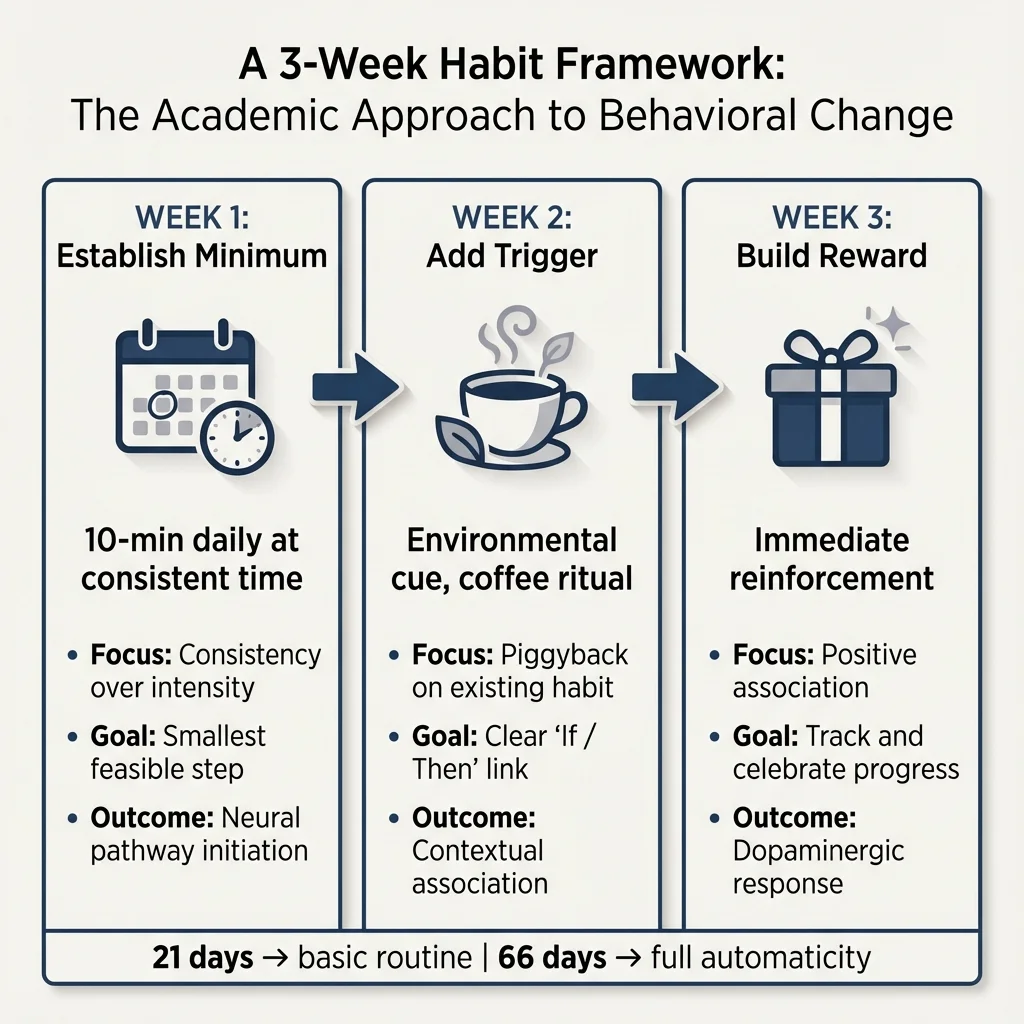
The 3-Week Starter Plan
- Week 1: Write 10 minutes daily at the same time
- Week 2: Add a trigger (coffee, a set spot, a set chair)
- Week 3: Add a quick reward (a treat, a short walk, a check mark)
It takes 21 days for the basic habit. Full automaticity takes about 66 days.
What Top 5% Productive Writers Actually Do
Robert Boice (30-year study)
Top writers share habits, not special discipline. They produce 2-4x more through steady systems, not long sessions or raw talent.
Top writers share these habits:
- Write no matter their mood
- Keep sessions short (30-90 minutes max)
- Write at the same time and place
- Track output without judging it
- Get back on track fast after breaks
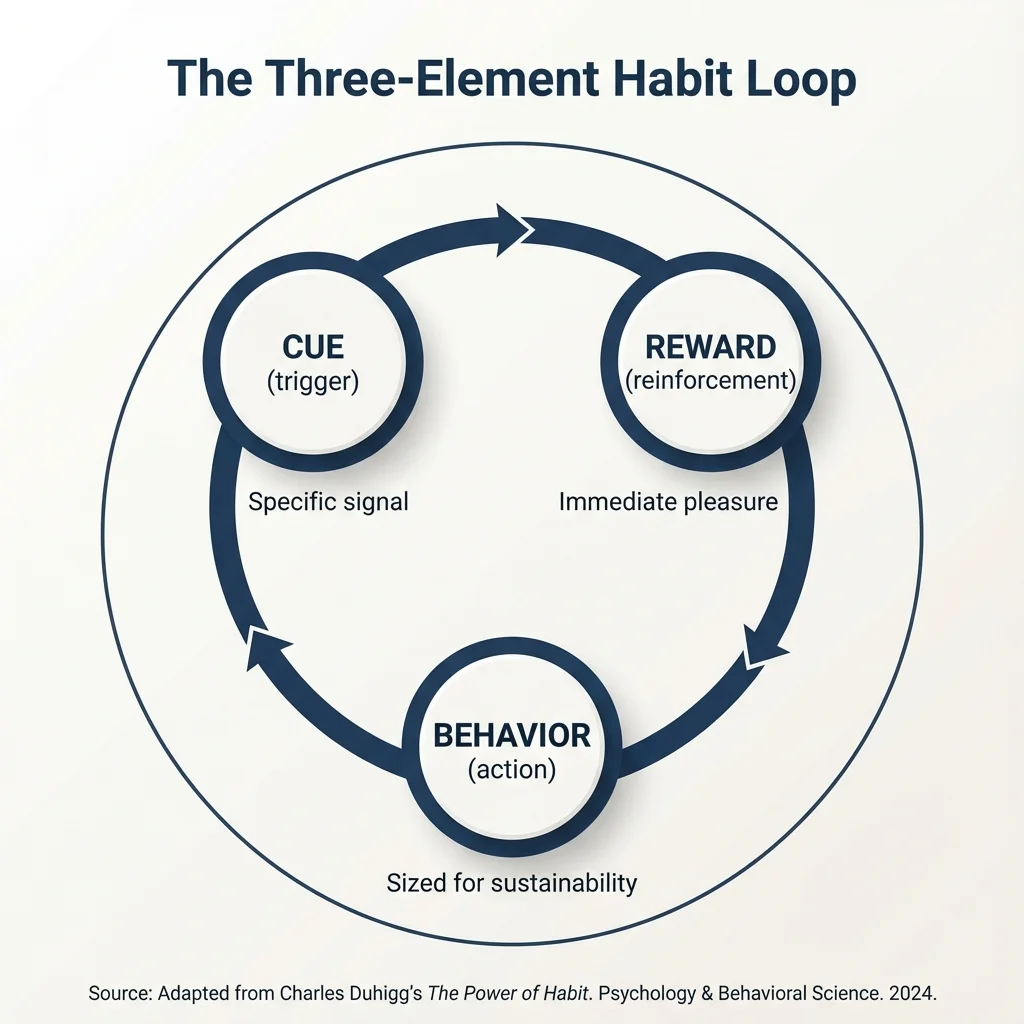
The Three-Element Habit Loop
1. Cue (Trigger)
A set signal that starts the habit.
- Works: "After morning coffee, I write for 10 minutes"
- Fails: "Write when I feel like it"
2. Task (Routine)
A small action we can keep up.
- Works: 5-10 minute sessions at first
- Fails: 2-hour sessions from day one
3. Reward
A quick, fun thing right after writing.
- Works: A treat, a fun site, a short walk
- Fails: Waiting until the weekend, or self-punishment
Seven Evidence-Based Building Elements
- 1. Start tiny: Only grow the time after 21+ days in a row
- 2. Set a plan: Name the time and place ("When X, I write at Z")
- 3. Shape the space: Make writing easy. Make distractions hard.
- 4. Never skip twice: One miss is fine. Two in a row leads to quitting.
- 5. Track showing up, not quality: Just count sessions. Building completion awareness helps keep us going.
- 6. Use fresh starts: Reset on Mondays, month starts, or new seasons
- 7. Guard the streak: Long streaks fuel themselves through visual tracking
Handling Disruptions
The 2-Minute Rule
When life gets in the way, write for just 2 minutes. One sentence or one quick edit. Do not skip the whole day. Even a tiny session keeps the habit alive.
Plan for Hard Times
Know that travel, deadlines, or illness will come. Pick the smallest task we can do on those days.
How to Restart
After a lapse, pick a fresh start date like next Monday. Start clean instead of trying to resume the old routine.
In a survey of 847 writers, daily writers used set times (89% vs. 34%). They used set spaces (76% vs. 41%). They tracked streaks (82% vs. 28%). They used short sessions of 30 minutes or less (71% vs. 38%).
- Set the cue: "When [time], I write for 10 minutes at [place]"
- Pick a quick reward we can enjoy within 60 seconds
- Choose how to track (calendar X's, an app, or a counter)
- Do at least three days in a row before judging results
- If life gets in the way, use the 2-minute rule at once
- After seven days in a row, guard the streak as our top fuel