Research shows that the gap between sitting down and making usable text is one of the biggest factors in writing output.[1] Some sessions recover from a slow start. Others never do. The first twenty minutes tend to set the path for all that follows.
Most of us know this from the inside. We open the file and watch the cursor blink. The gap between intent and action feels too wide to cross. The blank page carries real weight for many writers. It holds the built-up pressure of all the writing that did not come easy.
Writing warm-up exercises narrow that gap. Research in writing studies and cognitive psychology shows they work by priming the right brain paths. They reduce evaluation apprehension. They lower how hard the task feels before real drafting begins. Below are seven warm-up exercises with some evidence behind them, along with notes on when each works best.
The 7 Writing Warm-Up Exercises
These are sorted from lowest to highest mental demand. Most writers find one or two that work for them. The best approach is to try each for a week before picking a default.
- Freewriting: Write nonstop for 10 minutes to bypass the inner editor
- Yesterday's Draft Review: Reread and lightly edit the last thing written to get back into the project
- Sentence Completion Prompts: Finish stems like "The main point I want to make is.." to prime brain paths
- The Low-Stakes Paragraph: Write one throwaway chunk about the topic with no plan to keep it
- Copy-Typing: Retype two or three paragraphs of great writing to wake up motor and language patterns
- Voice Memo Transcription: Speak the ideas aloud first, then write them down
- The 5-Minute Micro-Draft: Write for five minutes on the hardest section to break avoidance through limits
Exercise 1: Freewriting (The Research-Backed Default)
Freewriting means ten minutes of nonstop writing. No editing, no pausing, no fixing. The method comes from Peter Elbow's 1973 book Writing Without Teachers. He argued that most writing trouble comes from trying to create and judge text at once. These are two very different brain tasks. They clash when run side by side.[2]
How to do it: set a timer for ten minutes. Write about the topic, or write about not knowing what to write. The cursor does not stop. If stuck, "I don't know what to write" is fine. Quality does not matter. Nonstop motion is the whole point.
Why it works as a warm-up: freewriting splits creating from judging. This cuts the mental load that causes startup freeze. Research on writing anxiety (notably Daly and Miller's work on a scale for it) found that worry about output quality is one of the best predictors of avoidance.[3] Freewriting cuts this off by removing quality from the picture. The inner editor cannot object to a sentence meant for no one.
This exercise works best when the blank page feels truly scary. When perfectionism is high, when the stakes feel too big, or when starting fresh with no prior work. For a deeper look, see our full deep dive on freewriting or the piece on writing anxiety and its cognitive roots.
Exercise 2: Yesterday's Draft Review
Rather than starting cold, spend ten to fifteen minutes rereading and lightly editing the latest draft. Not a full revision, just a re-entry. The goal is to reconnect with the voice, argument, and direction before picking up where we left off.
How to do it: open the last thing written. Read from the start of the most recent section. Fix small things to re-enter the text: typos, a clumsy phrase, a sentence to tighten. The key signal is when new ideas start forming. That is the moment to stop reviewing and switch to drafting.
The brain process here draws on what is called priming. Seeing related ideas wakes up linked brain paths. This makes recall and creation faster and easier.[4] Rereading prior work pre-loads the right mental network. When drafting starts, the ground is already known. Hemingway used a version of this. He would stop mid-sentence so he could pick up the thread the next day from a point of motion, not a cold start.
This exercise works best on ongoing projects where some motion already exists. It is less useful for cold starts on all-new topics with no prior draft.
Exercise 3: Sentence Completion Prompts
Finish five to ten sentence stems designed to prime thinking on the topic. These work as brain scaffolding, not creative writing prompts. They give just enough structure to cut the paralysis of the open field.
Some stems to try: "The main argument I want to make is.." / "A reader might push back because.." / "The one thing I know for sure is.." / "What surprised me most was.." / "The section I'm least sure about is.."
How to do it: write each stem and finish the sentence fast, without deep thought. Speed matters. These are rough first tries. The goal is forward motion, not careful thinking.
Sentence stems cut the mental load of "what do I write?" by adding structure. Research on constrained writing shows that shrinking a task's open feel reduces worry and boosts idea flow. The vast blank page shrinks into a set of fill-in-the-blank items.[4]
This exercise helps most with hard topics where scope feels too big, or when the argument is still unclear. If perfectionism is the main block, the low-stakes format of sentence stems may help more than freewriting, which offers no scaffold at all.
Exercise 4: The Low-Stakes Paragraph
Write one chunk about the topic with the clear plan to throw it away. It does not need to be good. It does not need to be used. Its only job is to exist.
How to do it: open a blank file, separate from the real draft. Write one chunk (four to six sentences) on the topic. The only rule: no editing. Close the file without saving. If something useful came out, paste it into the draft. If not, it still served its purpose.
This targets what studies call "evaluation apprehension." That is the fear of making bad work that stops us from making any work. By setting the stakes at zero, the exercise removes the pressure that causes paralysis. Research on academic writing found that low-stakes daily writing, removed from the formal drafting context, cut blocking in faculty writers by a lot.[5] The throwaway chunk is a practice run with all outcomes removed.
This works best for high-stakes writing. Reports for bosses, journal papers, grant bids, reviews. Cases where the pressure to "get it right" is so high that it stops us from starting at all. See also our piece on perfectionism as a cognitive block for related tips.
Exercise 5: Copy-Typing
Pick a piece of writing we admire. A strong article, a clear summary, a great passage from a book. Retype it word for word for five to ten minutes. Not to copy. As a drill, just like musicians learn by playing known songs before they improvise their own.
How to do it: pick two or three paragraphs. Type them out by hand. Pay mind to sentence flow, rhythm, and word choice. The goal is letting the patterns of strong prose flow through the hands. Not to memorize or study the text.
Copy-typing turns on the motor and language systems used in writing. But it needs no new ideas. The mental demand is very different from drafting. Nothing to think up, judge, or decide. The text is already there. What changes is the body state of the writer. The hands move, the language brain fires, and the body recalls what writing feels like. Benjamin Franklin used a version of this. He read and then rebuilt admired passages from memory as his main method for building prose style.[4]
This exercise works best when we feel cut off from language itself. When sentences feel clumsy, the writing voice will not show up, or a long break has broken the feel of writing. It helps most for writers coming back after illness, travel, or a long time away.
Exercise 6: Voice Memo Transcription
Talk about the topic for three to five minutes into a voice memo app. Then listen back and write down the key ideas. Speak as if telling a curious friend. Keep it loose. No need for formal structure. The recording is raw stuff. The notes become the seed for the draft.
How to do it: press record and talk. Do not aim for a polished talk. After, listen back and note the clearest, most useful ideas. These become the working matter for the drafting session.
Speaking skips what we might call the "writing filter." This is the extra layer of mental work that writing adds on top of thinking. Research on oral writing methods shows that speaking can cut worry and boost fluency for writers who find typing itself hard. Turning thought into speech demands less brain power than turning thought into written prose.[4] The step of writing it down then serves as a low-stakes bridge between speech and text.
This works best for writers who can explain ideas well in talk but freeze when they sit down to type. It also helps for complex topics where ideas need to be spoken and heard before they can be sorted. For writers building broader systems to support steady output, the behavioral block article covers the structural conditions that make any warm-up more likely to stick.
Exercise 7: The 5-Minute Micro-Draft
Set a timer for five minutes. Write the hardest or most dreaded section of the project. Do not pick an easy part. Target the section that has been avoided the longest.
How to do it: find the section that feels hardest or has been put off the most. Set a timer for five minutes. Write as much as possible. When the timer stops, stop writing. Read what came out.
This uses a firm rule from behavioral psychology: action comes before drive, not the other way around. Most writers wait to feel ready before they tackle the hard part. But the sense of being ready tends to come only after starting. The five-minute cap makes the task feel small. The act of starting often melts the wall that built up around the avoided section. Research on implementation intentions shows that spelling out what we will do and when we will do it boosts follow-through on hard tasks. It cuts the mental load of the in-the-moment choice.[6]
This works best for chronic avoidance of one section. When the same part gets put off session after session. If the avoidance is wider, the 8-session recovery protocol deals with the broader picture.
Choosing the Right Warm-Up: A Quick Decision Guide
Not all warm-ups serve the same purpose. The table below maps common problems to the exercises most likely to help:
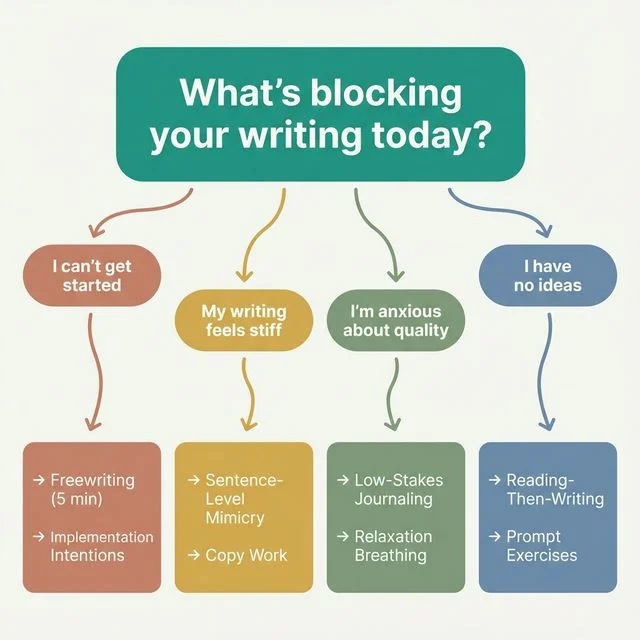
| If the problem is… | Try this warm-up | Why |
|---|---|---|
| Blank page paralysis or anxiety | Freewriting or Low-Stakes Paragraph | Reduces evaluation pressure |
| Lost momentum on an ongoing project | Yesterday's Draft Review | Re-primes existing work |
| Overwhelmed by scope or unclear argument | Sentence Completion Prompts | Scaffolds thinking |
| Disconnected from language or clumsy sentences | Copy-Typing | Activates linguistic patterns |
| Can explain ideas aloud but not on paper | Voice Memo Transcription | Bypasses the writing filter |
| Avoiding one specific section | 5-Minute Micro-Draft | Uses constraint to break avoidance |
Over time, most of us find a go-to warm-up and one or two backups. Testing each for a week and tracking which ones lead to good sessions is more useful than trying to guess in advance. Data from our own sessions teaches more than any generic tip. Building the chosen warm-up into a steady structure is covered in the writing routine article.
The Science Behind Writing Warm-Ups: Why They Work
The exercises came first because they matter more than theory. But knowing why warm-ups work tends to boost our resolve to use them.
Cognitive Priming
The brain does not shift into "writing mode" at once. The right mental tools need time to come online. Topic words, genre habits, and half-formed ideas from the last session all need to wake up. Priming research shows that seeing related ideas fires up linked brain paths. This cuts recall time and makes idea flow faster and easier.[4] Writing warm-ups work as a priming step. They shift brain resources toward the right zone before the hard drafting work begins.
Writing warm-ups serve the same role as stretching before a run. A runner who skips the warm-up runs worse. Not because their power is different, but because the right body systems have not reached peak speed yet. The same rule seems to hold for writing. The systems are mental rather than muscular, but the logic is the same.
Writing Apprehension Reduction
Daly and Miller's research on writing anxiety showed that it is a steady, measurable trait. It directly shapes writing behavior: how often writers avoid the desk, how long they delay, and how much they produce once they start.[3] Warm-ups that lower the stakes (freewriting, the throwaway chunk, sentence stems) target anxiety by splitting the warm-up from the real draft. The warm-up is prep, not the main event. That split, even if partly artificial, carries real weight for many writers.
Flow State Facilitation
Research on flow states finds that balance between challenge and skill is key to entering flow. The task must be hard enough to engage us but not so hard that it triggers anxiety.[7] The blank page breaks this balance for many writers. Not because drafting exceeds their skill. But because anxiety inflates how hard it seems. Warm-ups reset that view. After ten minutes of freewriting, writing feels more known. The brain systems are engaged. How hard it feels is closer to how hard it really is. This brings it into the range where flow can happen.
Building a Pre-Writing Routine
A warm-up is one part of a writing routine, not the whole thing. The most steady writers tend to use a simple three-part session:
- Warm-up (5–15 minutes): One of the seven exercises above, chosen based on the day's specific obstacle
- Drafting (25–45 minutes): The actual writing session, ideally with a timer and a target
- Cool-down (5 minutes): Note where to pick up next time, jot any unfinished thoughts, record what worked
This fits Robert Boice's research on brief daily writing. He found that academics who kept a steady session structure (no matter how they felt) wrote much more than those who wrote in sporadic bursts.[5] The cool-down is often skipped but it matters. Ending with notes on where to pick up kills the cold-start problem for the next session. The next warm-up gets shorter because the last session left a thread to pull.
For writers who gain from timed sessions, tools like unstoppable.ink offer a timed writing space built around this kind of structured session.
Common Mistakes with Writing Warm-Ups
A few patterns tend to hurt the value of warm-ups. They are worth naming head on.
Treating the Warm-Up as the Session
A warm-up that runs 45 minutes is avoidance with a nicer name. The limit matters. Fifteen minutes is a ceiling, not a hint. If the warm-up is going well and it is tempting to keep going, that is the moment to stop and switch to drafting. The motion is the point, not the warm-up output.
Using the Wrong Warm-Up for the Problem
Freewriting is great for anxiety but less useful when the block is lost steam on a project already in motion. Draft review helps ongoing projects but does nothing for cold starts. The table above is a practical guide, not decoration. Matching the exercise to the block tends to produce better results than using the same warm-up every day.
Skipping the Warm-Up on Easy Days
Easy days are not the ones that need warm-ups. Hard days are when warm-ups prove their worth. And hard days are when skipping them feels most tempting. This instinct tends to backfire. Doing the warm-up no matter what is what makes it a habit rather than a last resort.
Expecting the Warm-Up to Produce Usable Text
Warm-ups are prep for drafting. The only metric that matters is whether the session after it goes better. Judging a warm-up by whether it made usable text applies the wrong standard. A better test: did the drafting session that followed go better than it would have? That is the outcome warm-ups exist to produce.
Key Takeaways
- Warm-ups, done right and capped at fifteen minutes, tend to raise total session output rather than cut it
- Different blocks call for different warm-ups. Freewriting is the most studied default, but context shapes which exercise fits best
- The science behind warm-ups involves cognitive priming, writing anxiety reduction, and the conditions for flow state. All of these support easing into hard drafting rather than jumping in cold
- Building a warm-up into a steady session plan (warm-up, drafting, cool-down) adds up over time. The routine becomes habit. Startup cost drops
A good place to start: try freewriting for ten minutes before the next writing session. If that does not fit the block, the table above offers other options. After testing a few exercises over some weeks, a default tends to show up on its own.
References
- Boice, R. (1990). Professors as Writers: A Self-Help Guide to Productive Writing. New Forums Press. Boice's research documents the relationship between session startup patterns and overall writing output in academic writers. ↑
- Elbow, P. (1973). Writing Without Teachers. Oxford University Press. ↑
- Daly, J. A., & Miller, M. D. (1975). The empirical development of an instrument to measure writing apprehension. Research in the Teaching of English, 9(3), 242–249. ↑
- Kellogg, R. T. (1996). A model of working memory in writing. In C. M. Levy & S. Ransdell (Eds.), The Science of Writing: Theories, Methods, Individual Differences, and Applications (pp. 57–71). Lawrence Erlbaum Associates. Cognitive priming effects in writing and oral composition research draw on this working memory framework. ↑
- Boice (1990); see note 1 for full citation. The low-stakes daily writing findings are from the same volume. ↑
- Gollwitzer, P. M. (1999). Implementation intentions: Strong effects of simple plans. American Psychologist, 54(7), 493–503. ↑
- Csikszentmihalyi, M. (1990). Flow: The Psychology of Optimal Experience. Harper & Row. ↑