What Is Cognitive Block?
Thinking about writing gets in the way of writing. We have ideas. We have drive. But the drafting stalls.
Research found three forms:[1]
- Editing too much while drafting
- Rigid rules about the process
- Too much planning up front
Only 13% of blocks are purely cognitive. But 40-50% have a cognitive part.
Working Memory Overload
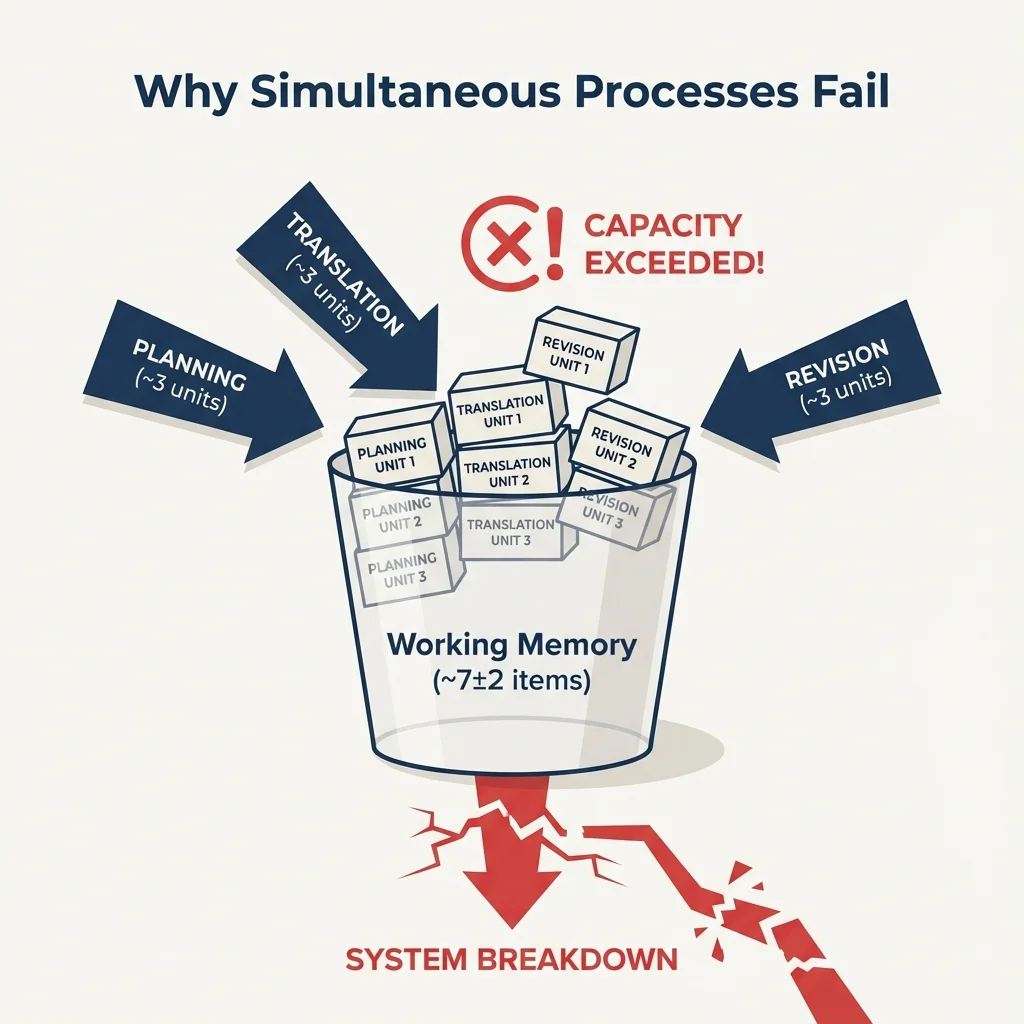
Writing uses three tasks at once. All three draw from our executive function system:
- Planning (what to say)
- Putting words down (how to say it)
- Fixing (checking quality)
Kellogg, R. T. (1996). A Model of Working Memory in Writing
We can't max out fluency, storage, and quality all at once.
Working memory holds about 7 items. Planning takes 3 slots. Writing takes 3. Fixing takes 3. With perfectionism on, the total is too high. The system breaks.
Five Rigid Rules That Block Us
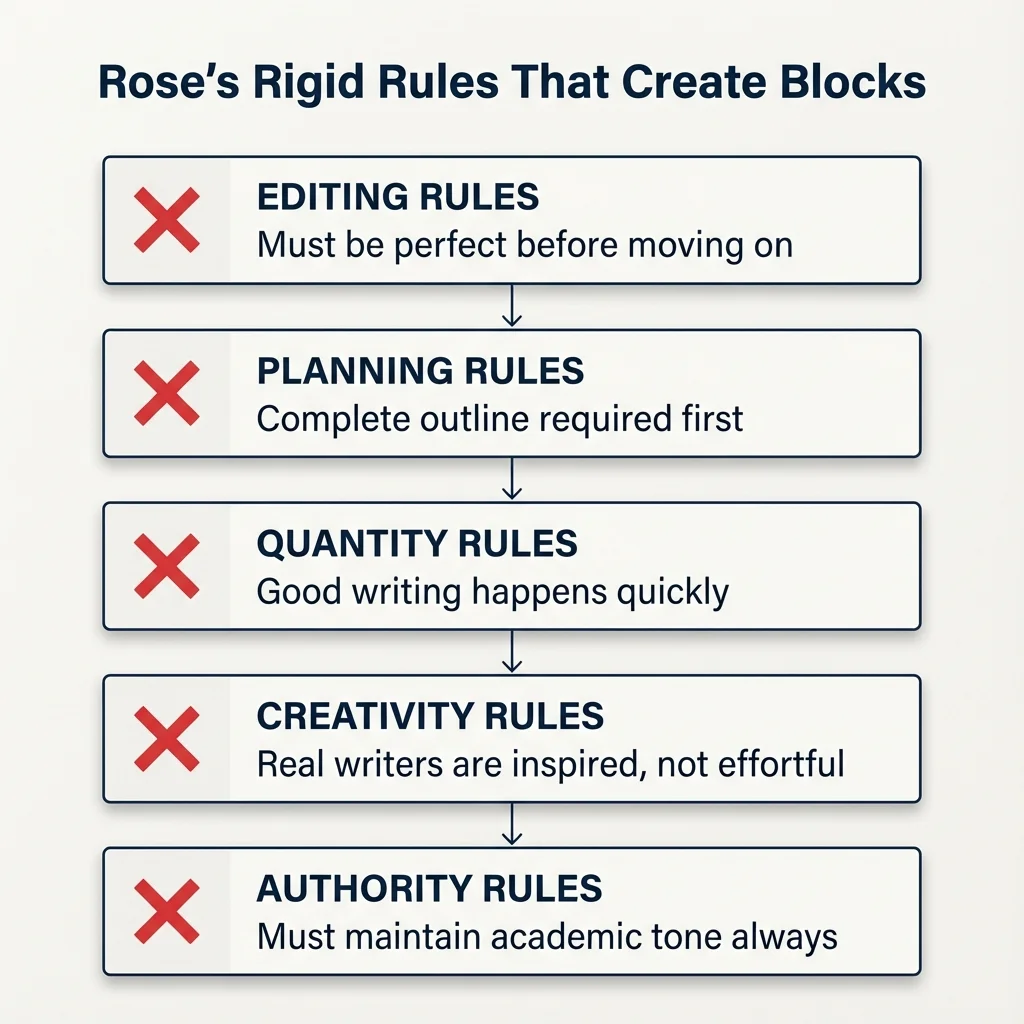
These five types of rules cause blocks:
1. Editing Rules (Most Common)
- "Sentences must be perfect before moving forward"
- "First drafts should be polished"
- "Real writers don't need revision"
2. Planning Rules
- "Complete outlining required before writing"
- "Must know the ending before starting"
3. Quantity Rules
- "Good writing happens quickly"
- "Slow writing indicates lack of talent"
4. Talent Rules
- "Real writers feel inspired, not stuck"
- "Hard writing means I lack talent"
5. Tone Rules
- "I must always sound formal"
- "Simple words mean simple thinking"
Four Signs of Cognitive Block
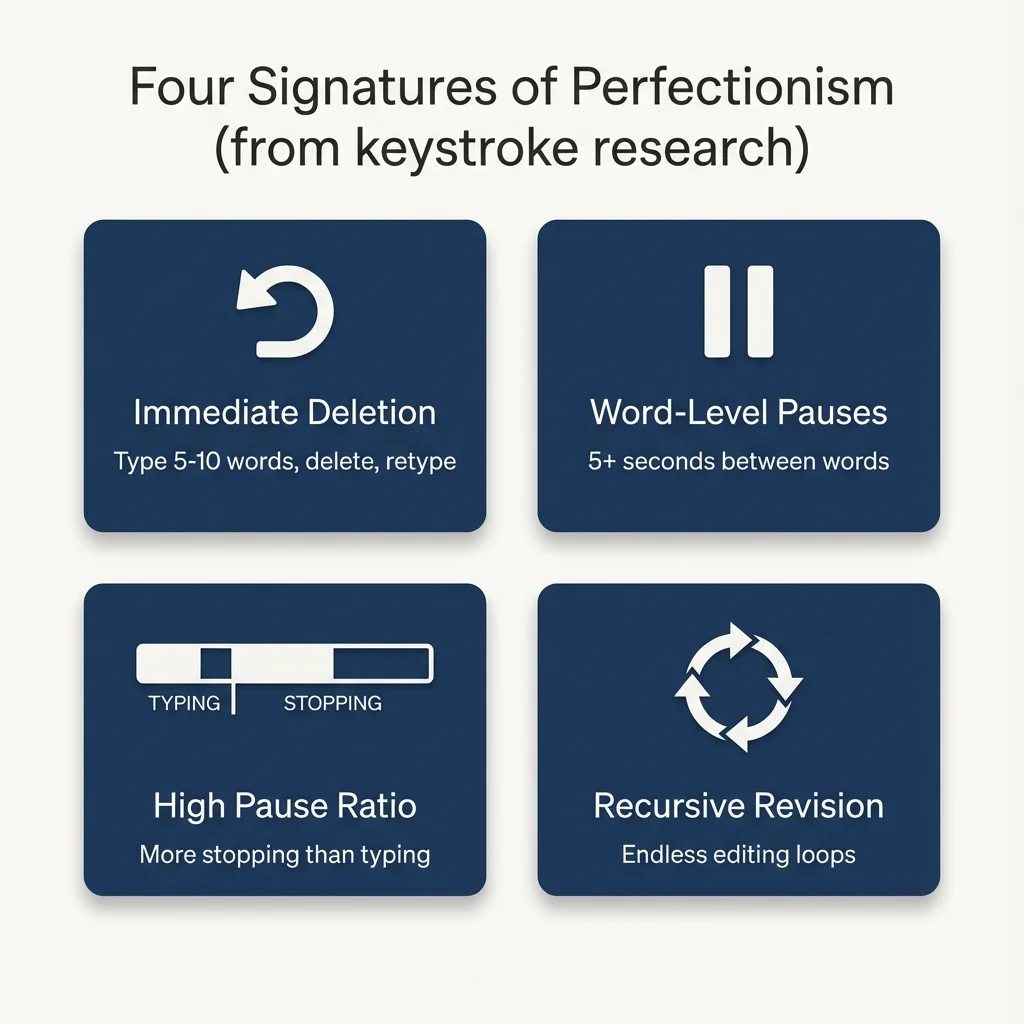
Keystroke research shows four clear signs:
- Quick Delete: Type a few words, erase them, retype
- Long Pauses: 5+ seconds between words
- More Pausing Than Typing: Time stalls on each line
- Going Back: Scroll up and rewrite done work
What Works
Need help right now? Our guide to fast fixes for perfectionism blocks has the quickest steps. Below is the full list.
Tier 1: Strong Evidence
- Set a 25-45 minute timer
- Write nonstop. No edits.
- Do not reread while drafting
- Edit later. Best: a new day.
- Set a 25-minute timer
- No edits until the timer ends
- Take 5-minute breaks between rounds
- The clock beats perfectionism
- Make an outline before drafting
- List key points and proof
- Follow the outline while drafting
- This frees up working memory
Tier 2: Some Proof
- Test Our Rules: Ask where they came from. Find proof they are wrong.
- Freewrite: Write 10-15 minutes daily. Never reread it.
- Bad First Drafts: We can fix bad prose. We can't fix a blank page.
What Does Not Work
- A walk (helps the body, not the mind)
- Prompts (helps planning, not writing)
- New setting (a behavioral fix, not cognitive)
- "Push through" (makes the overload worse)
References
- Rose, M. (1984). Writer's block: The cognitive dimension. Southern Illinois University Press. ↩